


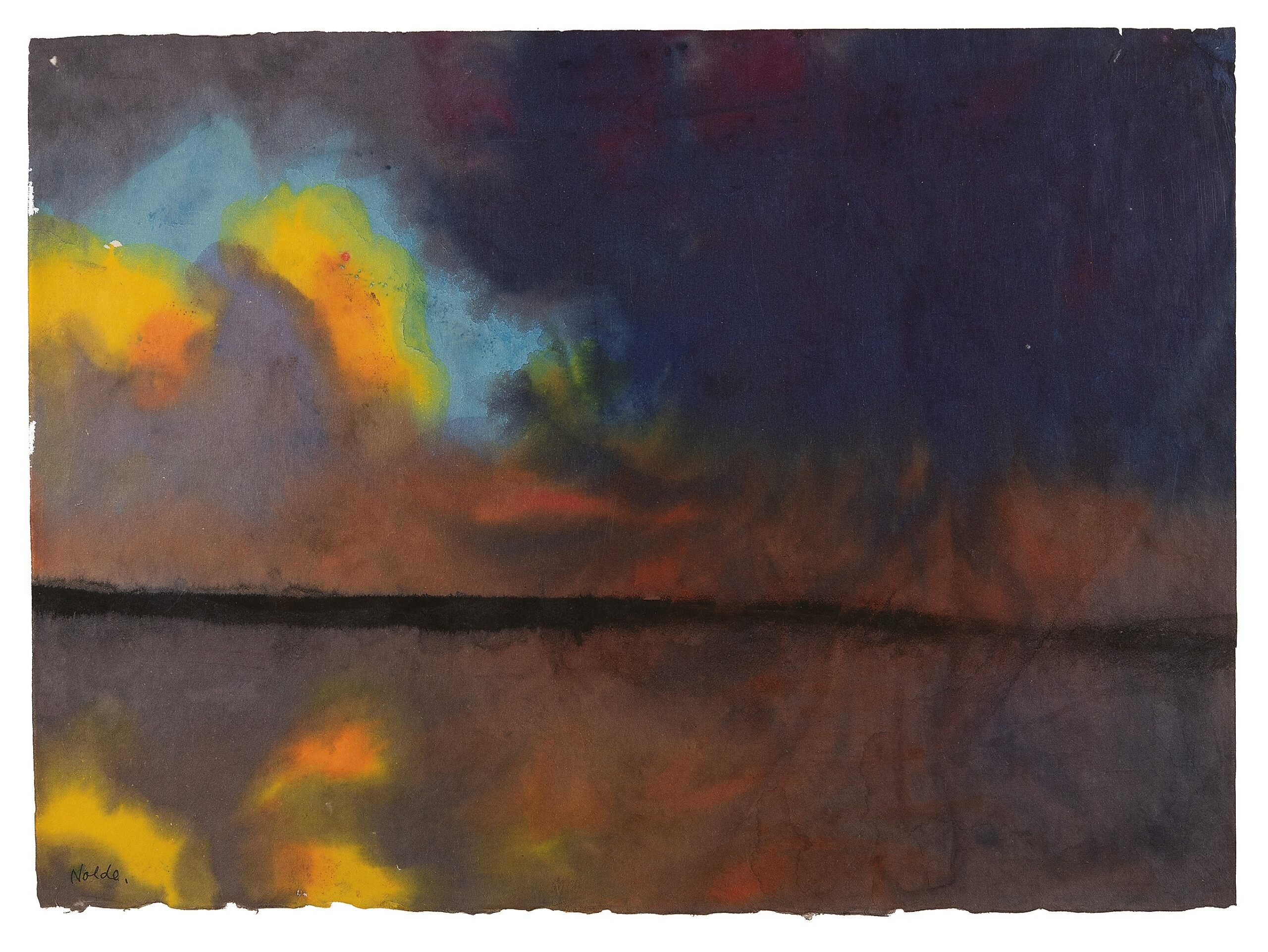
Nolde 1867 - 1956 Seebüll
Dark Sea with Cloud Reflection
o. J. , Watercolour on paper
34,8 x 47,8 cm
Emil Nolde is one of the most important watercolourists of the 20th century. His virtuosity is evident both in his painting technique and in his use of colour. Colour is his primary creative element: it determines not only forms and objects, but also mood, light and movement. Nolde developed his paintings directly from the painting process, using free strokes and the random circumstances of the moment.
The sea is one of the central themes in Nolde's work and appears in many variations. Growing up in the German-Danish border region of Schleswig-Holstein between the North Sea and the Baltic Sea, Nolde was familiar with and fascinated by the natural power of the sea from childhood. In his seascape watercolours, he used the spontaneity of the medium to create compositions of light and colour that allow the element of water to be experienced in its atmospheric entirety. Often, it is not only the sea, but above all the sky that is the actual event.
The watercolour "Dunkle See mit Wolkenspiegelung" (Dark Sea with Cloud Reflection) depicts a vast seascape beneath a dramatically darkened sky. An almost horizontal dark line marks the horizon and divides the composition into two zones: the cloudy sky in the upper part and the calm water surface in the lower part. The sky is dominated by deep blue and violet, overlaid with dense, cloud-like areas of colour. On the left, bright yellow and orange areas stand out, appearing like breaks in the cloud cover. These intense colour accents continue in the water surface as reflective reflections. In the lower part of the work, the colours appear more muted and flat, with transitions between shades of grey, brown and blue, creating the impression of a heavy, atmospherically charged mood.
The painting style is characterised by soft transitions, glazed layers and deliberately allowed colour mixtures. Nolde worked without preliminary sketches and painted watercolours on absorbent Japanese paper, often using the wet-on-wet technique. The brush left hardly any traces; the transitions appear fluid and hazy. Irregularities in the application of paint and visible edges of the glazes emphasise the immediate character of the watercolour and allow the creative process to remain present in the picture. Landscapes found their way into Nolde's watercolour painting from around 1918 onwards, but precise dating is rarely possible, as is the case with "Dunkle See mit Wolkenspiegelung". Here, the sea and sky condense into an almost abstract appearance: not as a topographical location, but as a pure, intense experience of nature and atmosphere.


