


Nürnberg 1471 - 1528 Nürnberg
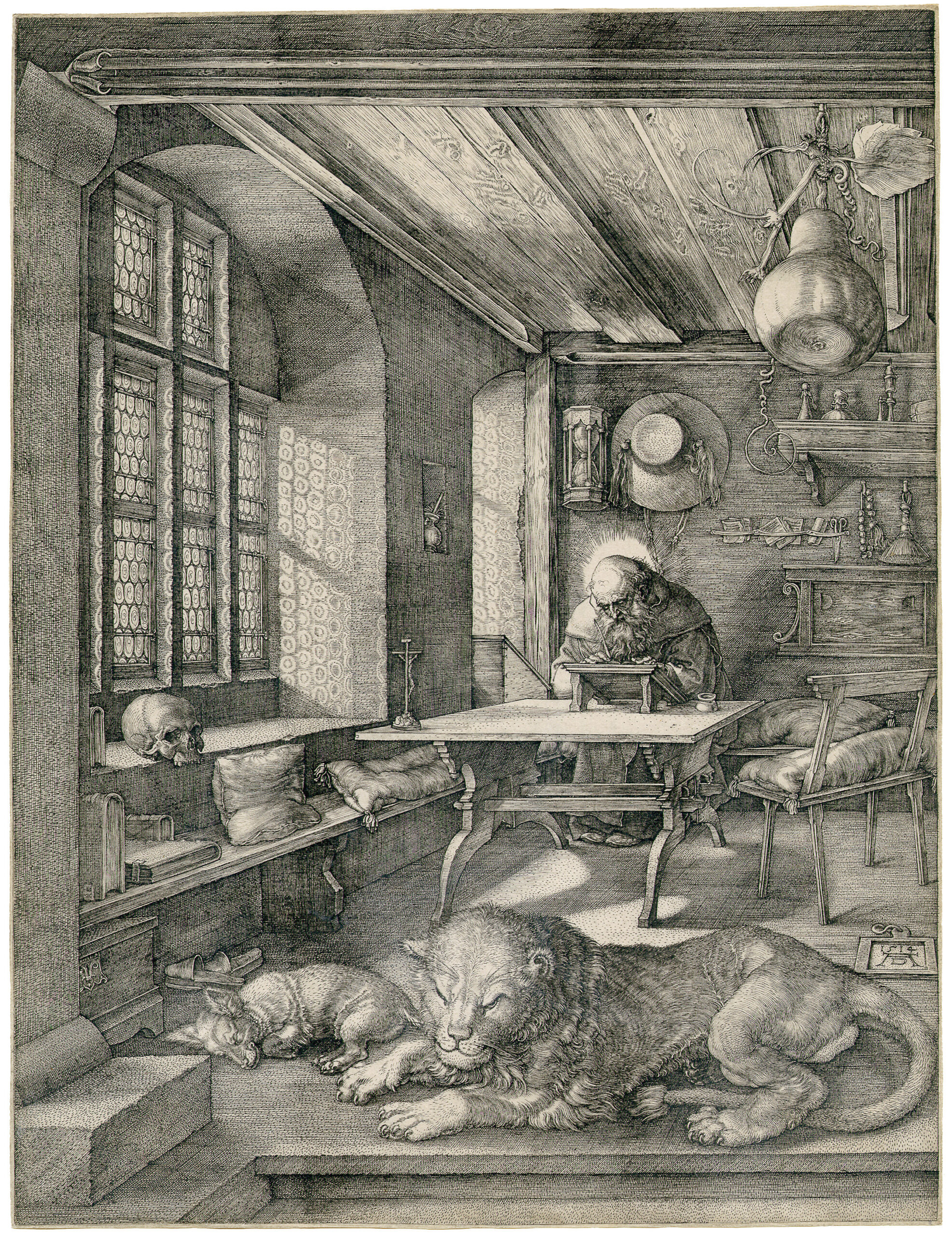
Saint Jerome in his study
1514, Etching
24.9 : 18.9 cm
Between 1513 and 1514, Durer created his “Three Master Engravings” in almost identical sizes, which have long been assumed to form a conceptual unity. In a room designed according to the rules of central perspective, we see the favourite saint of humanistically educated society translating the Bible from the original Greek text into the Latin Vulgate. The effect of the sheet is based largely on the texture of the various objects, depicted with great virtuosity, such as the soft fur of the lion, the crumbling edges of the hard masonry, and the lively grain of the wooden beam ceiling. The rendering of the light falling through the bull’s-eye panes of the windows and painting delicate curls on the masonry and window struts is unique.
With this depiction, Durer joins a broad tradition of pictorial representations of St. Jerome. The image of the scholar developed from Christian ideas in early humanism in Italy and shows the scholar reading or writing in his study. Durer’s depiction is part of a humanistic cult of St. Jerome that also flourished in Nuremberg in the early 16th century. When Lazarus Spengler, who like Durer lived in Zisselgasse, began translating the Latin biography “De morte Hieronymi” written by Bishop Eusebius of Cremona into German around 1512, Durer was certainly involved.
Magnificent, impression with strong contrasts. The strong light flooding the room bathes it in a sacred glow and creates a friendly atmosphere in this quiet scene. The vertical band is very prominent, which is a sign of an early impression.
Horizontal hanging fold smoothed. The border line partially replaced with ink and pen. Narrow strip around the image carefully restored.


